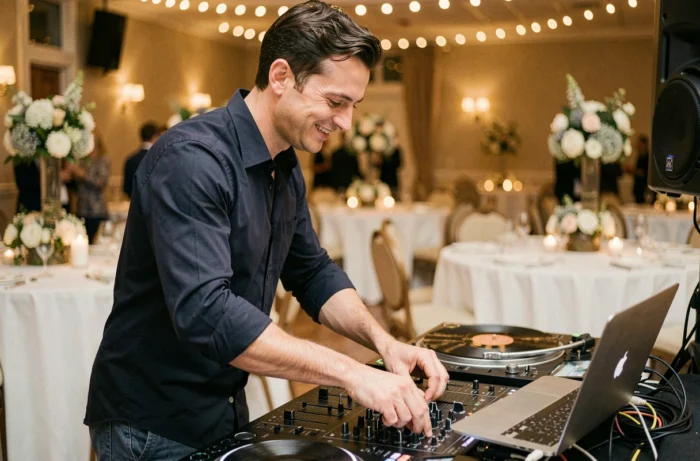
A wedding DJ does not simply play music. They manage the rhythm of your evening, the transitions between each highlight, the sound volume, and the energy of your guests. Choosing this provider means entrusting the atmosphere of your reception to one person for several hours. It goes without saying that the decision deserves more than a quick glance at a price.
Sound regulations and wedding DJs: what your venue imposes
Even before comparing providers, one point conditions everything else: the regulations on amplified music in reception venues. Since the decree of April 17, 2023, venues open to the public are subject to strict constraints. The average sound level must not exceed 102 dB(A) over 15 minutes, with a maximum peak at 118 dB(C).
In practice, many wedding venues are now equipped with sound limiters. If your DJ is not aware of these thresholds, they risk having the sound cut off in the middle of the dance floor. An experienced professional adapts their music programming and equipment to these constraints without your guests noticing.
Additionally, there has been an increase in municipal decrees since 2023, which restrict amplified music outdoors after 10 PM or 11 PM depending on the municipality. If your ceremony or cocktail takes place outdoors, ask the DJ and the town hall before signing anything.
Several couples share this type of feedback on the wedding DJ forum on La Mariée Rêveuse, where issues related to sound volume frequently come up in testimonials.
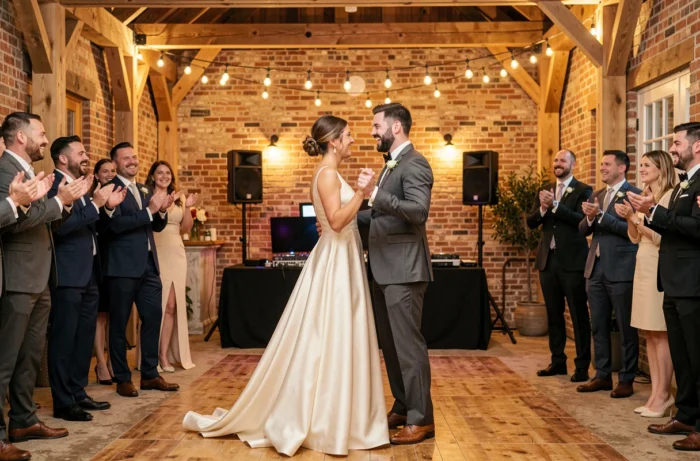
DJ equipment: what really changes the atmosphere of the evening
Have you ever attended an event where the sound crackles, the bass distorts, or the microphone for speeches is inaudible? The equipment makes all the difference, and a good DJ brings their own.
A professional DJ owns and masters their own equipment. Those who rent at the last minute take a risk with quality and reliability. During your first exchange, ask for details on three specific points:
- The speakers and their power, suitable for the size of your reception venue (a 200 m² room is not soundproofed like an open garden).
- The setup planned for the civil ceremony, which requires dedicated wireless microphones for officiants and witnesses, separate from the dance party system.
- The ambient lighting (light shows, projectors), often included in the service but whose quality varies greatly from one DJ to another.
If the DJ is vague about their equipment or refers you to the venue for sound, consider this a warning sign.
Contract and insurance for the wedding DJ: clauses to check
The contract is the least glamorous part of the preparation, but it is the one that protects you on the big day. Three clauses distinguish a reliable provider from an amateur who improvises.
The first concerns the duration of service. Many DJs charge a flat rate that ends at midnight or 1 AM. Your evening is in full swing at that time. Check the rate for additional hours and negotiate a guaranteed end time (2 AM, 3 AM) upon signing.
The second clause to look for: replacement in case of impediment. An accident, an illness, and your event is left without entertainment. A serious DJ plans for an identified replacement in the contract, with an equivalent level of competence.
The third point: professional liability insurance. It covers material damages (a cable that trips a guest, a speaker that falls) and sound damages. Request a certificate, not just a verbal assurance.
The issue of deposits and cancellation
A reservation deposit is normal. What matters are the cancellation conditions. Read the refund terms before paying any money. A well-drafted contract specifies the deadline beyond which the deposit is lost, and the cases of force majeure that entitle you to a full refund.

Choosing your wedding DJ: concrete signals during the meeting
Technical skills can be verified on paper. The chemistry is judged face-to-face or via video. Why is this meeting decisive? Because the DJ will be in direct contact with your guests throughout the reception. Their interpersonal skills matter as much as their playlist.
During this exchange, observe how they respond to your musical requests. A good DJ accepts a list of must-play songs and a list of must-not-play songs. But they also explain why certain transitions work better than others. A DJ who says yes to everything without providing reasoning likely lacks experience.
Ask for a video recording of a recent wedding, not a studio mix. The difference is significant: a studio mix shows their musical tastes, while a party video shows their ability to read the room, to revive the dance floor when the energy dips, and to manage transitions between the meal and the entertainment.
Personalized playlists are not enough
Many couples focus on the music programming in advance. Preparing a playlist is useful, but the real skill of a wedding DJ lies in real-time adaptation. If the dance floor empties during a planned track, they must know how to pivot within seconds. This reactivity cannot be detected on a website. It is evident in performance videos and detailed customer reviews.
The choice of a wedding DJ hinges on verifiable elements: compliance with sound regulations, personal equipment mastered, a complete contract with a replacement clause, and a genuine recording of the event. Focus your energy on these four points rather than comparing dozens of quotes. A provider who checks these boxes will allow you to enjoy your day without any worries.