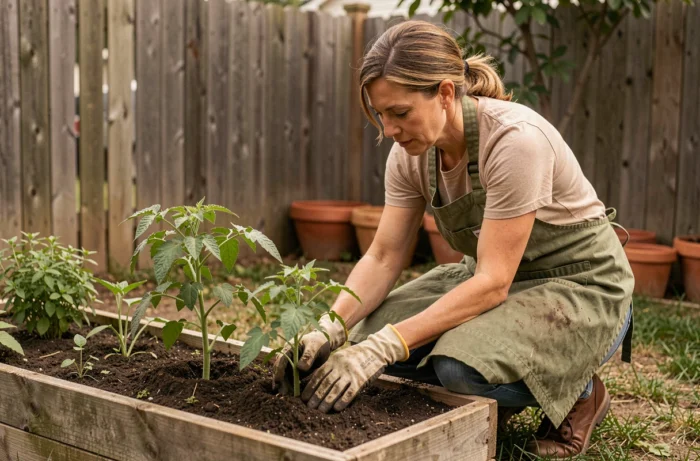
Daily gardening relies on three pillars: knowledge of the soil, respect for plant cycles, and access to reliable resources to make the right decisions at the right time. Whether the goal is a productive vegetable garden, a flower-filled terrace, or an ornamental garden, the quality of the information consulted directly affects the results obtained in the field.
Soil and substrate: understanding what happens beneath the surface
Before choosing a plant or planning sowing, the first resource to mobilize concerns the soil. Clay soil is not worked like sandy soil, and the analysis of soil texture determines all subsequent decisions: amendments, watering frequency, planting depth.
The ribbon test, which involves rolling a handful of moist soil between the fingers, already provides a useful indication. If the soil forms a pliable ribbon without cracking, it contains a significant proportion of clay. If it crumbles immediately, the sandy component dominates.
The systematic mulching of beds and the vegetable garden significantly reduces the need for watering and weeding. This practice, which has become widespread in recent years, transforms the daily management of the garden by limiting evaporation and gradually nourishing the soil through decomposition.
To delve deeper into each topic according to the season or type of crop, useful information on Jardinier.net covers a wide range of practical sheets categorized by theme.
Lunar calendar and sowing planning
The lunar calendar remains a resource consulted by many gardeners to plan sowing, transplanting, and harvesting. The principle is simple: certain phases of the moon are believed to favor the growth of aerial parts (leaves, fruits), while others stimulate root development.
The market for gardening applications that follow the moon has recently undergone a shake-up. The historic app “Lune & Jardin” has disappeared from major stores, making way for two free French-speaking apps considered serious alternatives for tracking lunar cycles in the garden.
Beyond the moon, sowing planning relies on a calendar adapted to the climatic zone. The dates of the last frosts vary greatly from one region to another, and sowing too early in the open ground can wipe out several weeks of work.
Organizing your vegetable garden month by month
Rather than sowing everything in March, an approach of successive waves ensures staggered harvests. Lettuce, for example, should be sown every three weeks from spring to autumn to avoid having a concentrated production over a few days.
- Leafy vegetables (salads, spinach, lamb’s lettuce) tolerate late sowing until early autumn and adapt to restricted spaces, including in containers on a terrace.
- Fruit vegetables (tomatoes, zucchinis, peppers) require starting indoors several weeks before being planted outdoors, with particular attention to light conditions.
- Root vegetables (carrots, radishes, beets) prefer loose, deep soil, and too compact soil produces misshapen roots that complicate harvesting.
Gardening applications and plant recognition by photo
In recent years, a new generation of French gardening applications has transformed the daily management of vegetable gardens and ornamental plants. These tools now integrate functions of smart assistant with photo recognition and highly localized weather tracking.
The Hortenia app, for example, offers personalized support that cross-references local weather data with the specific needs of each registered plant. This type of tool does not replace direct observation but usefully complements the gardener’s know-how by signaling priority interventions.
What these tools concretely change
Photo recognition allows for identifying a disease or pest in seconds. Where a gardener previously had to consult an illustrated paper guide or post a photo on a forum, the diagnosis is now almost instantaneous.
Hyperlocal weather tracking (at the neighborhood level, not the departmental level) refines watering decisions. An afternoon shower makes morning watering unnecessary, and the app automatically signals this.
Watering in the garden and vegetable garden: adapting frequency to actual needs
Watering is the area where mistakes cost the most, both in water and results. Abundant but spaced watering is better than light daily watering, as it encourages roots to go deep in search of residual moisture.
Water needs vary greatly from one vegetable to another. Tomatoes, once well established, can tolerate periods without water if the soil is mulched. Salads and radishes, on the other hand, require consistently moist soil or they will bolt prematurely.
- On a terrace, containers dry out much faster than open ground: daily monitoring of the substrate is necessary in summer.
- Rainwater collected in a tank is preferable to tap water, which is often too calcareous for some acid-loving plants (hydrangeas, camellias).
- A mulch of a few centimeters thick reduces evaporation and limits water stress between waterings.
Observation remains the most reliable resource: soil that sticks to the fingers does not need water, while soil that crumbles to dust does. No application, no matter how sophisticated, can replace this simple gesture that takes a few seconds each morning.
Daily gardening progresses less through the accumulation of tools than through the regularity of actions and the precision of information mobilized at each stage. A well-understood soil, a respected calendar, and resources consulted at the right time make the difference between a garden that survives and a garden that produces.