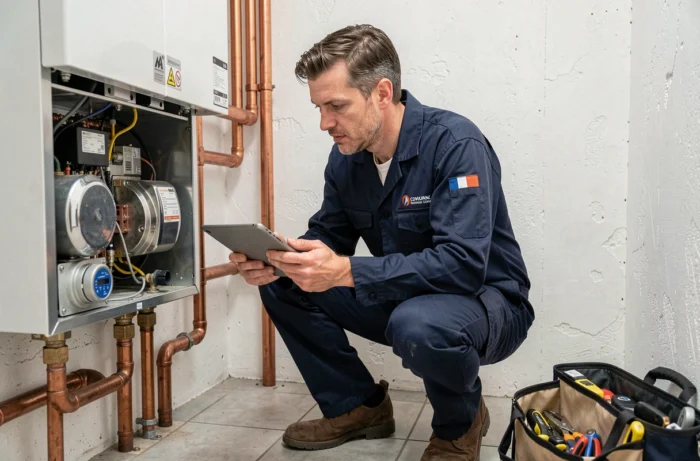
In Brussels, heating represents the largest energy expense for a home. Choosing a heating professional is not just about comparing prices: Brussels regulations are evolving quickly, and an installer who is not up to date may lead you to non-compliant equipment. Here are concrete guidelines for making an informed choice.
Prohibition of oil heating in Brussels: what your heating technician should know
As of June 1, 2025, the installation of an oil boiler is prohibited in Brussels, including as a replacement for an existing unit (unless an exemption is granted). This regulatory change directly filters professionals: a heating technician who still offers an oil boiler for a Brussels project is not current.
Specifically, this prohibition pushes towards three main alternatives: the condensing gas boiler, the heat pump, and hybrid systems. A competent professional should be able to explain which option is suitable for your building, taking into account the existing insulation and the distribution network (high or low-temperature radiators).
This regulatory point is also a good test during an initial contact. Ask the question directly: an installer who hesitates or is unaware of this prohibition reveals insufficient technical awareness. To delve deeper into the Brussels legal framework before contacting a professional, you can read on Facefull News the points to check in advance.

Heating technician certifications in Belgium: which ones to check
A professional certification is not a marketing label. In Belgium, some certifications correspond to legal obligations, while others represent voluntary quality commitments. Distinguishing between them helps avoid relying on empty commercial arguments.
Cerga and gas accreditation
The Cerga certification confirms that an installer understands safety standards for natural gas. It is issued after a technical examination and must be renewed. A heating technician working on a gas boiler without this certification exposes the client to non-compliance risks, particularly during the mandatory PEB inspection in Brussels.
Qualification for heat pumps
With the planned phase-out of oil and increasing restrictions on gas, the heat pump is gaining ground. Installing this type of system requires specific skills in refrigeration. Check that the professional has the appropriate qualification and has completed several projects similar to yours.
Requesting a copy of the certifications before signing a quote is not an excessive step. A serious professional will present them without difficulty.
Comparing heating quotes: beyond the total price
Receiving three quotes is a common reflex. The trap is to compare only the bottom line. A detailed heating quote protects better than a low price, because it allows you to verify what is actually included.
Here are the elements that should appear on a serious quote:
- The brand and exact model of the proposed device, along with its nominal power and energy label.
- The cost of labor separated from the cost of materials, to identify where the discrepancies between quotes lie.
- Additional costs: compliance of the exhaust duct, hydraulic connection, thermostatic valves, programmable room thermostat.
- The duration and conditions of the warranty, both on the device and on the installation.
A quote that combines everything into a single line “supply and installation” prevents any real comparison. Disregard it.
Warranty and after-sales service
The manufacturer’s warranty on a condensing boiler generally covers the heat exchanger for several years, but the warranty on labor depends on the heating technician. Ask the question before signing: who intervenes in case of a breakdown during the warranty period, and within what timeframe?
A professional who handles after-sales service and annual maintenance himself offers a continuity that resellers without a technical workshop cannot guarantee.
Boiler maintenance in Brussels: an indicator of reliability
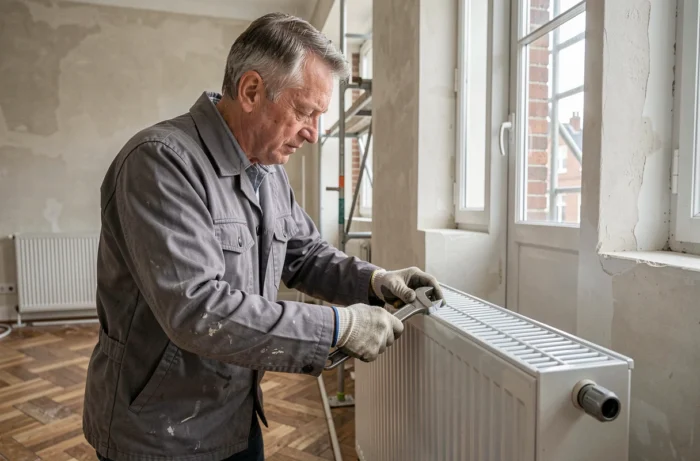
Annual maintenance of a boiler is mandatory in Belgium. In Brussels, this obligation is accompanied by the issuance of a control certificate. A heating technician who offers a maintenance contract from the installation shows that he is committed to a long-term relationship.
This contract presents a concrete advantage: in case of a breakdown, clients under contract are often prioritized. During winter cold peaks, the difference between an intervention within 24 hours and a wait of several days can be significant.
Also check the geographical proximity. A heating technician based in the Brussels-Capital Region or its immediate outskirts will reduce travel times, which impacts intervention costs and emergency responsiveness.
References and customer reviews: how to leverage them
Online reviews provide a trend, not a certainty. A professional with a few dozen coherent and detailed reviews inspires more trust than a profile displaying hundreds of perfect ratings without comments.
More useful than review platforms: ask the heating technician for references of recent projects comparable to yours. Installing a heat pump in a 1930s Brussels apartment does not require the same skills as a gas boiler in a new construction.
Contact one or two of these references. The most revealing question is not “are you satisfied?”, but rather: “was there an unforeseen issue, and how was it managed?” Problem management distinguishes a good heating technician from a mere equipment installer.
The Brussels heating market is undergoing a regulatory transition that makes choosing a professional more technical than before. An installer who knows the current prohibitions, details his quotes, and ensures follow-up after installation remains the best investment for the lifespan of your system.