
Buying a bib, a sleeping bag, or a car seat from your phone takes less than two minutes. Choosing the right product for your baby, one that is safe, suitable for their age, and truly useful, requires a bit more method.
Online catalogs are filled with references, and product sheets do not always make it easy to sort between the superfluous and the necessary. This guide details concrete benchmarks for making online purchases of childcare products without unpleasant surprises.
GPSR Regulation: What Changes for Childcare Products Sold Online
You may have noticed that some product sheets now display the name of a responsible party based in the European Union? This is a direct consequence of the Regulation (EU) 2023/988 on the general safety of products, applicable since December 13, 2024. This text, often referred to by its acronym GPSR, concerns almost all non-food items sold to consumers, including childcare accessories.
Specifically, three points change the game for parents shopping online. Manufacturers located outside the EU must designate a responsible party established in the Union. Marketplaces are held more accountable when a non-compliant product is put up for sale. And the mandatory information on the product sheet is strengthened.
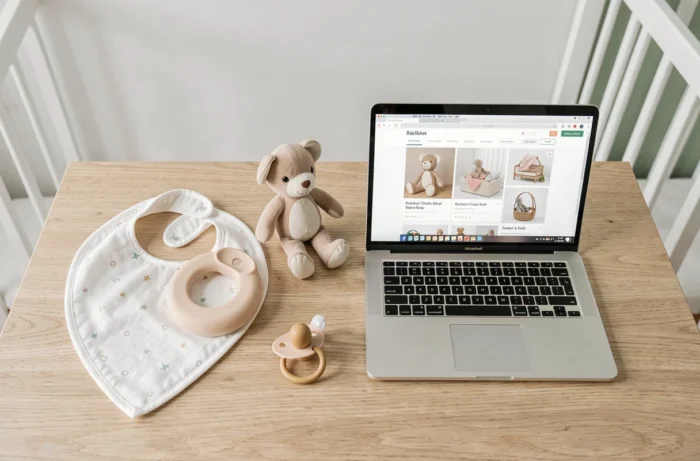
Before adding an item to your cart, check that the sheet clearly mentions a responsible party identifiable with an address in the EU. If this mention is absent, it is a warning signal, especially on large marketplaces that host third-party sellers. By browsing baby accessories on Maman Bébés, you will find selections that already take these compliance criteria into account.
Decoding a Childcare Product Sheet: Reliable Benchmarks
A well-taken photo and a reassuring description guarantee nothing. The product sheet is, however, the only document you have before making a purchase. Knowing how to read it correctly can avoid many returns.
Standards and Labels to Check
For sleep items (sleeping bags, mattresses, bed rails), look for the mention of the applicable European standard. A specified TOG index (for example, TOG 2 for winter, TOG 1 for mid-season) indicates that the manufacturer has tested the thermal resistance of the fabric. A sleeping bag sold without any mention of TOG or standards raises doubts about the manufacturer’s rigor.
The CE marking is not a quality label; it is a declaration of conformity to European requirements. It must appear on the product or its packaging. Its absence on the online sheet deserves a direct question to the seller before any order.
Composition and Care
Babies put objects in their mouths, sleep on them, and sweat into them. The textile composition (organic cotton, polyester, fleece) and washing instructions must be clearly stated. A sheet that omits this information is often a sign of a reseller who does not master their own catalog.
- Check that the fiber composition is indicated in percentage, not in vague terms like “soft material” or “premium fabric.”
- Look for the maximum washing temperature: a baby item that cannot withstand a wash at 40 °C will quickly become problematic in daily use.
- Check for the presence of a textile certification (Oeko-Tex, GOTS) when the seller claims a product is “free from harmful substances.”
Sorting the Useful from the Superfluous Before Birth
The pre-filled baby lists offered by some sites sometimes contain several dozen references. Why buy a bottle warmer if you are exclusively breastfeeding? Why plan for a baby bouncer from the first month when the baby will sleep most of the time?
Starting from the real needs of the infant rather than a standard list helps reduce unnecessary purchases. A newborn needs to sleep, be fed, changed, transported, and dressed. These five functions dictate the priorities.
Items to Buy First
- A compliant crib with a firm and breathable mattress, without pillows or comforters: a safe sleeping arrangement is the non-negotiable foundation.
- Enough bodysuits and pajamas to last between two washes, about ten pieces in newborn size.
- A carrying system or stroller suitable from birth, with a harness and incline compatible with an infant who cannot hold their head up.
- The changing essentials: diapers, cleansing lotion or water, waterproof changing mat.
The rest (baby monitor, food processor, connected night light) can wait a few weeks. You will then know what you really lack in your daily life, rather than guessing from a catalog.

Avoiding Common Pitfalls of Online Baby Shopping
Shopping online exposes you to specific risks that physical stores naturally limit. Here are the most common situations and ways to protect yourself.
Baby Clothes: Sizes Vary from Brand to Brand
A 3-month size bodysuit from a French brand does not necessarily correspond to the same size from a Spanish or Turkish manufacturer. Rely on the weight and length in centimeters indicated in the size guide rather than the displayed age. If the size guide is absent, move on.
Product Recalls: How to Stay Informed
The RappelConso platform, managed by the French authorities, lists recalled or withdrawn products. Checking this database before a costly purchase (car seat, travel crib, high chair) takes less than a minute and can prevent a safety issue. The data is freely accessible and continuously updated.
Customer Reviews: Read Between the Lines
A product rated 4.8 stars based on 12 reviews inspires less confidence than an item rated 4.3 based on 400 reviews. Favor comments that describe long-term use (“after three months of use, the zipper holds well”) rather than reviews posted on the day of receipt of the package.
Childcare accessories purchased online fulfill their role when they meet a specific need, comply with current standards, and come from an identifiable seller. The most cost-effective reflex remains to check the product sheet with the same attention as one would read a label in-store, because the screen does not replace touch, but a well-informed sheet more than compensates.