Creating an interior that is both elegant and harmonious does not necessarily require a large budget or the intervention of an architect. A few targeted choices regarding colors, materials, and furniture arrangement are enough to transform a room. Here are ten concrete ideas to rethink your interior decoration, from the living room to the kitchen.
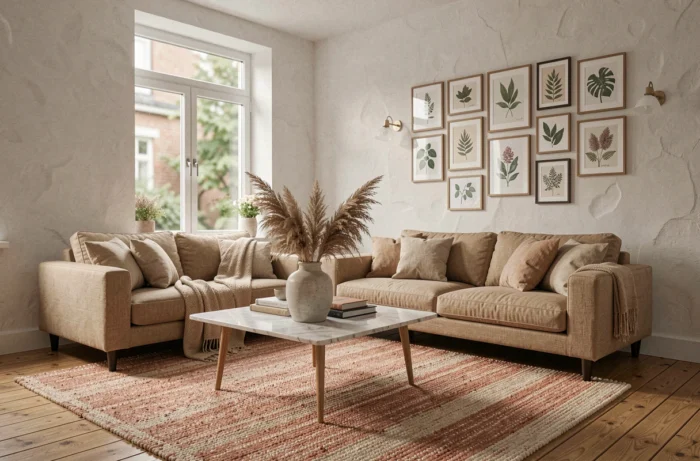
1. Limit the palette to three colors per room
Have you ever noticed that a space feels confusing without being able to say why? Often, the problem comes from an excess of shades competing for attention. Three colors maximum per room are enough to create a readable atmosphere.
Choose a neutral dominant (off-white, beige, light gray), a secondary color for the furniture or a wall, and a third color in small touches on cushions or a vase. This simple rule avoids missteps and makes it easier to add decorative objects over time.
Recent trends highlight deep blues and rich greens as secondary colors, capable of adding character without overwhelming the space. Test a paint sample on a square meter before diving in: the natural light in your room significantly alters the appearance.
2. Invest in a sculptural piece of furniture as a focal point
A living room gains personality when the eye is immediately drawn to a strong element. A curved velvet armchair, an organic-shaped walnut coffee table, or an asymmetrical bookshelf play this role of focal point.
Finding tips for successful decoration starts with this reflex: identify the centerpiece before decorating around it. The rest of the furniture should remain understated, in materials and tones that do not compete with this central piece.
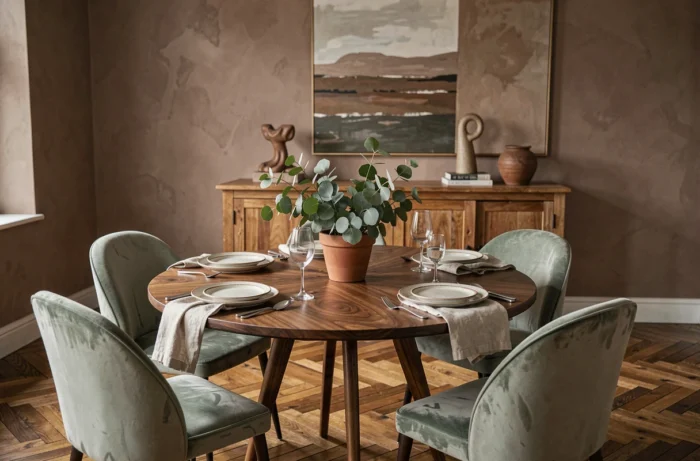
One strong piece of furniture per room prevents visual overload. If your dining room already has a large raw wood table, there’s no need to add very colorful chairs and a sculpted sideboard.
3. Play with materials rather than patterns
Layering materials adds depth to an interior without complicating visual reading. A linen sofa, a thick wool rug, and a brushed metal table create a pleasant tactile contrast.
This approach suits both minimalist Japandi styles and more expressive decors. Varying textures compensates for the sobriety of a neutral palette. A mohair throw draped over a leather armchair is enough to warm up an entire living room.
4. Place a large mirror facing the light source
A well-placed mirror does two things at once: it visually enlarges the room and redistributes natural light. Positioned opposite a window or near it, it reflects daylight into the darker areas of the living room or entrance.
Opt for a generous size (at least half the height of the wall) rather than an accumulation of small decorative mirrors. The frame, whether in wood, gold metal, or rattan, adds style without cluttering the space.
5. Multiply light sources at different heights
A single ceiling light flattens the atmosphere. For a warm ambiance, combine at least three types of lighting in your living room:
- A high ambient light (pendant or ceiling light with a dimmer)
- Mid-height accent lamps (floor lamp, wall sconce) to modulate intensity according to the moment
- Low spot lighting (table lamp, discreet string lights) that creates intimate zones in the evening
Each light source shapes a different volume in the room. Vary the color temperatures: warm white for the sofa area, a more neutral white for the kitchen countertop.
6. Integrate plants suited to the actual light
Biophilia, this trend that reconnects the interior to nature, works only if you choose plants compatible with your space. A ficus in a dark hallway will yellow within weeks.
Identify the orientation of your windows. On the north side, opt for shade-tolerant species (pothos, sansevieria). On the south side, an indoor olive tree or a dwarf lemon tree will thrive. A healthy plant decorates better than three wilting plants.
7. Declutter before decorating
Adding objects to an already saturated space produces the opposite effect of what is desired. Before any decorating effort, clear the room of what is not useful or no longer pleases you. This often-overlooked step radically changes the perception of a living room or bedroom.
Hide the cables, remove the knick-knacks accumulated out of habit, and free up horizontal surfaces. A piece of furniture with a clear top immediately looks more stylish, even if it is not luxurious.
8. Hunt for a vintage object as a signature
A completely new interior often lacks character. A vintage object (brass lamp, antique mirror, reupholstered armchair) adds a touch of history that cannot be replicated in series.
The mix of eras works when there is a coherence of materials or colors. A light wood chair from the 1960s fits well into a Scandinavian interior. The found object tells a story that new furniture cannot offer.
9. Consider circulation before aesthetics
A beautiful living room where you bump into the coffee table while passing loses all its charm in daily life. Before deciding on the placement of furniture, mentally trace the paths you take most often: entry to kitchen, sofa to bathroom.
Leave at least the width of an outstretched arm between two pieces of furniture in a frequently used passage. In a living room with a dining area, the two-thirds (living room) and one-third (dining area) rule helps to distribute the volume evenly.
10. Prioritize durable and traceable furniture
The European regulation ESPR, which came into effect in July 2024, gradually imposes sustainability, reparability, and recycled content requirements on furniture manufacturers. In a few years, every piece of furniture sold in the European Union will need a digital product passport detailing its origin and composition.
In practical terms, choosing furniture designed to last reduces the need to replace and redecorate frequently. A sofa with a solid wood frame and washable covers will endure several decor trends without ending up in the landfill. It’s an aesthetic choice as much as an ecological one.
The most successful interior decoration relies less on the accumulation of objects than on the coherence between colors, materials, and circulation. Each room has its constraints of light and volume: start from there rather than from a catalog, and your interior will find its balance naturally.