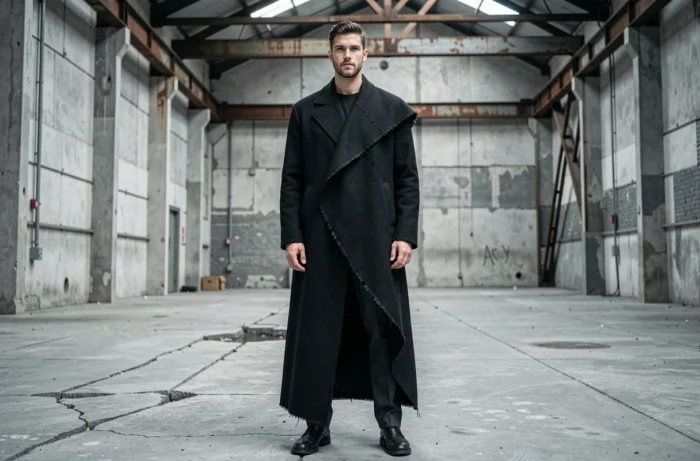
Carol Christian Poell does not communicate, no longer showcases in a conventional format, and refuses any form of marketing. His work lies at the intersection of technical clothing and sculptural objects, with manufacturing processes that have no equivalent in the ready-to-wear industry, even within the avant-garde segment.
Object dyeing and post-production treatments at Carol Christian Poell
The process that most distinctly sets CCP apart from his contemporaries is object dyeing, a dyeing technique performed on the fully assembled garment. The result differs radically from traditional piece dyeing: the leather, threads, closures, and linings absorb the pigment unevenly, producing a chromatic depth that is impossible to replicate industrially.
Specialized boutiques like Iconostasio now catalog CCP pieces with precise technical suffixes (“O.D.” for object dyed, “drip-rubbered” for drip rubber treatments). These codes are not commercial jargon. They describe actual post-production steps that alter the very structure of the material.
The drip-rubber treatment applied to certain leather jackets adds an irregular protective layer that alters the drape and weight of the piece. We observe that each item becomes de facto unique, as the rubber flows according to gravity and ambient temperature at the time of application. Finding the complete Carol Christian Poell collection on BreizhPower – The 100% Breton magazine! allows one to measure the extent of these variations from one model to another.
Integrated prosthetics: when the CCP garment extends the body
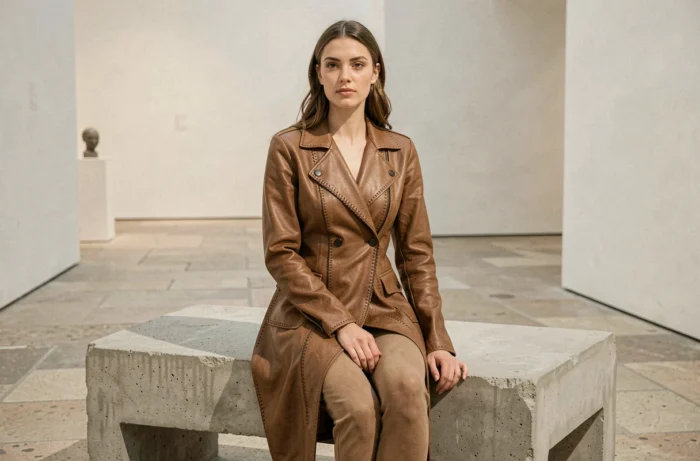
Models with integrated elbow and hand prosthetics represent the most radical axis of recent production. The LF/0899GOP references documented by Iconostasio show leather jackets whose sleeves incorporate rigid anatomical extensions, sewn into the lining and visible only through their effect on the silhouette.
This is not an ornamental detail. The prosthetic modifies the wearer’s gestures: the elbow joint partially stiffens, and the hands adopt a fixed posture. The garment imposes a body language, reversing the usual relationship between the body and clothing.
This approach brings CCP closer to wearable sculpture than to fashion design. The piece does not accompany movement; it constrains and redefines it. We recommend physically manipulating these models before any purchase, as photos do not convey the weight or restriction of mobility.
Carol Christian Poell in the resale market: speculative value and rarity
The near absence of current production transforms each CCP piece into a collectible item. Recent data from The RealReal indicates that the majority of luxury Gen Z buyers check resale prices before purchasing new. For a creator like Poell, who produces only in marginal quantities and has no traditional distribution network, this dynamic amplifies perceived rarity.
Prices in the secondary market do not follow the usual depreciation logic. Some models see their value increase significantly after a few years, particularly object dyed pieces and jackets with prosthetics. The primary market is limited to a handful of specialized retailers (Iconostasio, a few boutiques in Milan and Tokyo), making the resale channel often the only possible access.
Several factors contribute to this valuation:
- The total absence of reissues: CCP does not reproduce past models; each season constitutes a closed series.
- The controlled deterioration of materials: leather treated by object dyeing evolves over time in a way that collectors consider patina, not wear.
- The refusal of any commercial collaboration or licensing, which keeps the volume of pieces in circulation at an extremely low level.
Positioning of CCP between conceptual art and functional clothing
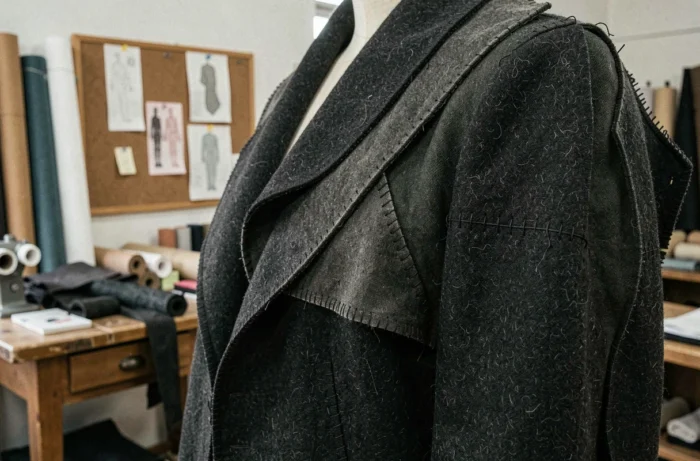
Classifying Carol Christian Poell in the “avant-garde fashion” category is reductive. The CCP garment functions as a conceptual art object worn daily, and specialized retail is beginning to openly acknowledge this. The product sheets from Iconostasio describe the processes (chain seam, object dyeing, prosthetic construction) with the precision of a gallery catalog.
This shift in commercial discourse is not trivial. It signals a change in market perception: the CCP piece is no longer sold based on style or trend, but based on a documented manufacturing process and verifiable rarity.
Nevertheless, these garments remain wearable. The chain seam overcoats (reference LM/2698) retain a functional structure: raglan sleeves, removable lining, classic closures. The radicality lies in the treatment of the material and in the construction details, not in a spectacular unusable form.
Referencing and documentation of Carol Christian Poell pieces
Each CCP model follows a dense alphanumeric referencing system that encodes the type of garment, material, applied treatment, and season. This system has never been officially published by the creator, but the collector community and specialized retailers have reconstructed its logic:
- The prefix (LM, LF) indicates the men’s or women’s line.
- The material suffix (CORS, ROOLS) refers to the type of leather used.
- The mentions PTC followed by a number encode the dyeing and finishing treatment.
- The suffix O.D. confirms the application of the object dyeing process on the finished piece.
Mastering this coding system allows for precise identification of a piece in the secondary market and helps avoid counterfeits, which remain rare but do exist. Reading the reference code is the first reflex for authentication even before the physical examination of the garment.
The absence of an official website, digital lookbook, and press release makes this community documentation all the more valuable. CCP remains one of the last creators whose archive is built from the ground up, piece by piece, among collectors and retailers who share their observations on treatments and seasonal variations.