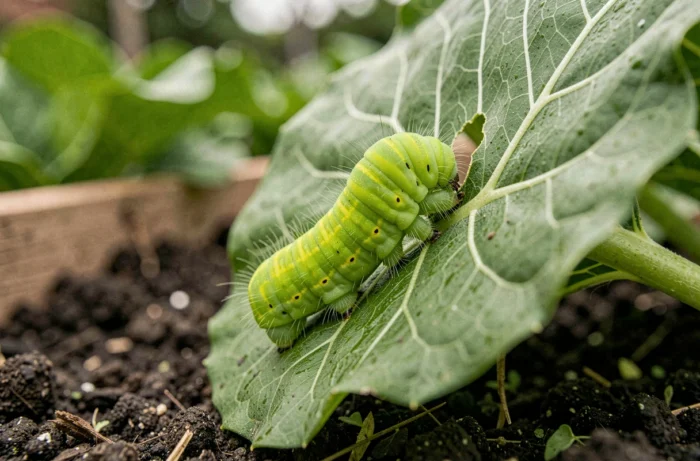
You come across it when turning over a tomato leaf or inspecting a row of carrots: a caterpillar of an intense, almost fluorescent green, motionless on the underside of the leaf. The first reflex is often to crush it. The second is to wonder if you have just eliminated a future butterfly that is beneficial to the garden. Before taking action, it’s better to observe a few precise details that change everything.
Host plant and false legs: the two clues that really matter
Color alone is not enough. Several dozen species of caterpillars display a bright green, and some are not even caterpillars of butterflies. The most reliable criterion for starting identification is the plant on which you find the larva.
A fluorescent green caterpillar on parsley, carrot, fennel, or dill strongly points towards the Swallowtail (Papilio machaon). On cabbage or broccoli, one would think more of the cabbage butterfly. On a rose bush or a currant bush, there’s a good chance it’s a sawfly, which is a larva of a hymenopteran that resembles a caterpillar without being one.
To distinguish a true butterfly caterpillar from a false caterpillar of a sawfly, count the false abdominal legs. True caterpillars have a maximum of five pairs of false legs, while sawflies have six pairs or more. You can check by gently turning the larva over and observing the ventral side of the abdomen.
This identification guide based on host plant and number of legs is more reliable than any color comparison on a screen. It also helps avoid the common confusion between the privet hawk moth (green with diagonal white stripes) and the tomato looper (uniform green, duller), two species that do not have the same impact on the garden at all. To accurately recognize a fluorescent green caterpillar in the garden, this cross-referenced method of plant and legs remains the most accessible without equipment.
Green caterpillar on cabbage, tomato, or carrot: three concrete scenarios
Rather than listing all the green species in France, let’s focus on the three most common situations in the garden.
Cabbage butterfly on brassicas
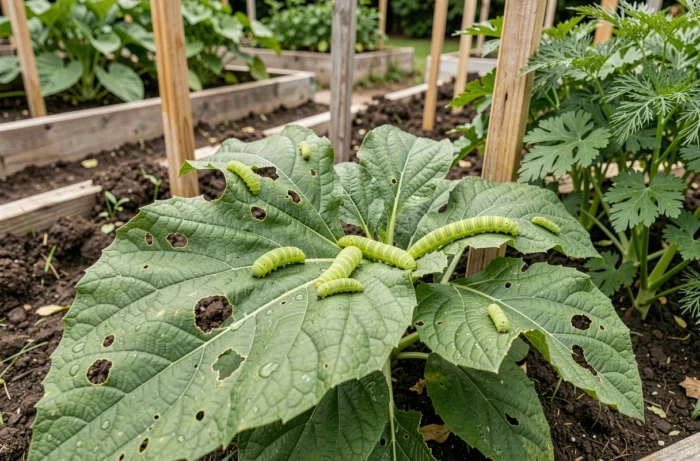
The caterpillar of the cabbage butterfly (Pieris brassicae) is green-yellow with black spots and longitudinal yellow lines. It is found in groups on cabbages, broccoli, and turnips. The damage can be massive in just a few days: leaves reduced to their veins, visible black droppings. This is one of the few cases where intervention is fully justified, even in a garden conducive to biodiversity.
Looper on tomato and lettuce
The loopers (Noctuidae) produce smooth green or brown caterpillars that hide in the soil during the day and nibble on stems and fruits at night. They are mainly spotted by the damage: round holes in tomatoes, cut collars on young lettuce plants. Their nocturnal behavior makes direct detection difficult. A check with a flashlight after dark remains the most reliable method.
Swallowtail on umbellifers
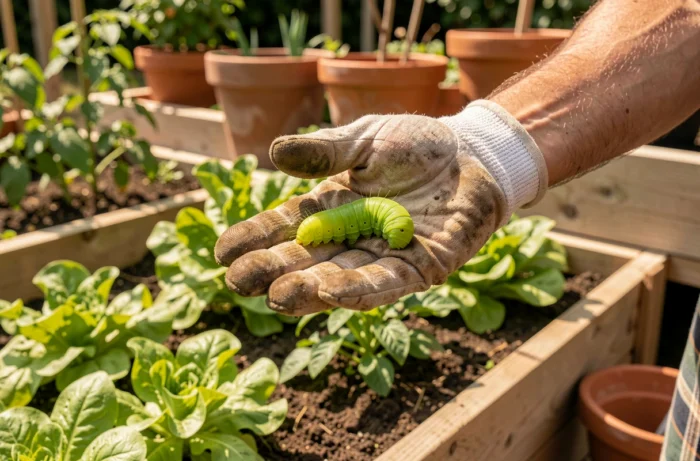
The caterpillar of the Swallowtail feeds on parsley, fennel, carrot, and dill. In its final stage, it displays a bright green striped with black and orange spots. It consumes foliage, but rarely in sufficient quantity to compromise a harvest. The Swallowtail is a protected butterfly in several regions, and its presence in the garden is rather a sign of ecological health.
Fluorescent green caterpillar: leave it or intervene in the garden
The answer depends on the identified species and the level of observed damage. The decision-making logic can be summarized in a few concrete points:
- If the caterpillar is a Swallowtail on umbellifers, leave it. The damage remains low and the butterfly contributes to pollination once it matures.
- If the caterpillar is a cabbage butterfly and the foliage is already riddled, intervene. Manual collection is usually sufficient for a modest-sized garden.
- If the caterpillar is a looper on tomato, monitor at night and remove the larvae by hand. Clean mulching around the plants also limits their daytime hiding spots.
- If you cannot identify the species, observe for two or three days. An isolated caterpillar that does not cause extensive damage can often be tolerated.
Feedback varies on this point, but generally, the systematic crushing of any green caterpillar impoverishes the biodiversity of the garden without always protecting the crops.
Pest management methods without chemicals in the garden
Manual collection remains the most direct and selective method. Inspect the undersides of leaves, especially on brassicas and solanaceae, early in the morning when the caterpillars are still relatively immobile.
Fine mesh insect nets, placed as soon as the cabbages are transplanted, prevent adult butterflies from laying eggs. This is the most effective prevention against the cabbage butterfly. Be sure to bury the edges of the net well to avoid ground passage.
Encouraging natural predators does the rest of the work. Great tits consume considerable amounts of caterpillars in spring to feed their broods. A tit nest box near the garden, diverse hedges, uncut areas: these arrangements reduce pest pressure in the long term without direct intervention.
Bacillus thuringiensis (Bt), a biological treatment allowed in organic farming, acts specifically on lepidopteran caterpillars. It is sprayed on the foliage and does not affect beneficials like ladybugs or bees. It is used as a last resort when manual collection is no longer sufficient in the face of a cabbage butterfly infestation.
The presence of green caterpillars in the garden is not a problem in itself. It is a sign of a living garden, where biological cycles are functioning. Identifying the species before acting, accepting a few holes in parsley leaves, reserving intervention for true pests like the cabbage butterfly or looper: this way, you protect both your harvests and the butterflies that pollinate the rest of the garden.