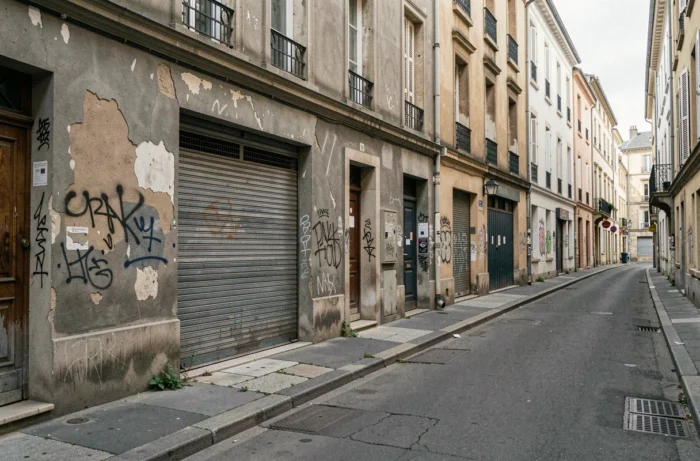
Lyon has recorded an increase in criminal activity in recent years, driven by property crimes and drug trafficking concentrated in a few micro-sectors. The city has about 520,000 inhabitants, but its daytime population far exceeds this figure, skewing any reasoning based solely on a rate related to residents.
Talking about “neighborhoods to avoid in Lyon” by entire districts amounts to condemning areas where the majority of streets remain calm. A precise approach based on specific points, times, and uses provides a more reliable reading.
Time and exact address: the true framework for security in Lyon
An entire district says nothing about the reality of a street. The 7th district has the highest rate of drug trafficking within Lyon’s city limits, but this statistic is concentrated around place Gabriel Péri in La Guillotière. The banks of the Rhône or the Jean Macé area, although in the same district, do not exhibit this profile.
The 9th district offers the same type of discrepancy. Vaise faces localized problems near certain streets close to the train station. The Saint-Rambert plateau, administratively attached to the same district, remains a calm residential area. For anyone looking to learn more about Le Blog Du Foncier, this distinction between a precise address and administrative boundaries changes the way to evaluate a property.
The time of day also alters the reading. Public squares bustling with families and shops during the day can concentrate tensions in the evening, particularly around certain metro stations in the 7th district. Conversely, calm areas in the evening sometimes experience drug dealing episodes in broad daylight, like certain building lobbies in Mermoz.
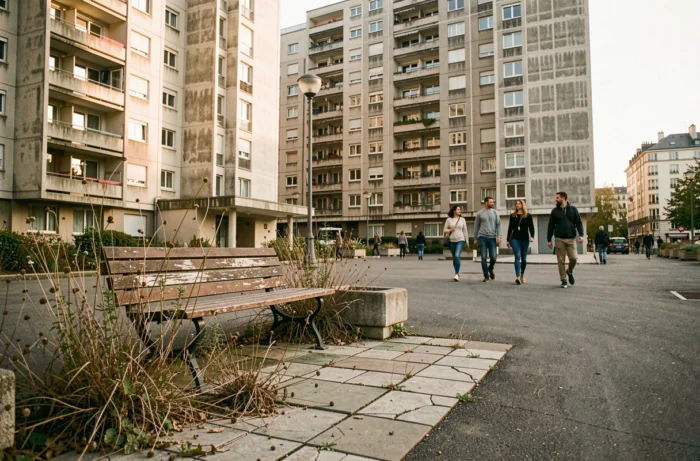
La Guillotière, Mermoz, La Duchère: distinct realities behind the common label
The term “sensitive neighborhoods of Lyon” encompasses situations that have little in common. The dominant type of problem, its impact on daily life, and the prospects for change vary significantly from one area to another.
La Guillotière: public space violence around a square
La Guillotière concentrates violence in public spaces, mainly at place Gabriel Péri and in the adjacent streets. Dense commercial life, marked cultural diversity, and active nightlife: tensions arise from a mix of precariousness, gentrification, and gatherings that escalate. The rest of the 7th district, towards Jean Macé or Halle Tony Garnier, does not present this profile.
Mermoz-Pinel: structured drug trafficking
The problem in Mermoz (8th) is of a different nature. The organized drug trafficking in the housing estates generates episodes of violence, sometimes armed, related to rivalries between networks. Gunfire in broad daylight, documented by residents and construction professionals working on-site, is not an isolated anecdote. The États-Unis neighborhood, neighboring in the 8th, faces similar issues at a lower intensity.
La Duchère: an inherited reputation, an ongoing transformation
La Duchère (9th) carries the image of several decades of large housing complexes. The neighborhood is undergoing an urban renewal program that has transformed part of the built environment. Field reports diverge on this point: some residents describe a tangible improvement, while others report a shift in tensions towards areas that have not yet been renovated.
Gerland in September 2026: when a neighborhood shifts into security news
Gerland shows how quickly the situation can change. In September 2026, the area was subject to increased police operations as part of a departmental plan to restore everyday security.
In the Lyon imagination, Gerland remains associated with urban renewal, the nearby Confluence, and recent real estate projects. The response from local authorities indicates that the situation there exceeds mere isolated incidents. For a buyer or tenant, this episode serves as a reminder that the security map of Lyon is redrawn from year to year.
The available data do not allow for a conclusion on whether this degradation is cyclical (the movement of a network from another neighborhood) or structural. The coming months will provide a clearer indication.
Evaluating a Lyon neighborhood: concrete criteria before signing
Rankings by district are not sufficient to decide on a rental investment or settling down. Several elements need to be checked on-site, at different times:
- The immediate proximity of an identified dealing point (lobby, square, underground parking), verifiable by passing through in the late afternoon and evening
- The condition of street lighting and nighttime pedestrian traffic between the housing and the nearest metro station
- The existence of an ongoing urban renewal program, likely to change the neighborhood profile in a few years (La Duchère, Gerland)
- The rent control rate in the sector, in effect in Lyon and whose impact on rental profitability varies by micro-neighborhoods
An apartment located three streets away from a tension point does not experience the same nuisances as a housing unit directly across from it. The price per square meter differences between districts are significant, but the differences within the same district can be just as pronounced.
Labeling an entire district as “to avoid” penalizes streets without issues and overvalues sectors whose flattering image masks recent tensions. Consulting the facts recorded by IRIS neighborhoods on data.gouv.fr, cross-referencing with an on-site visit at various times, and following local news (Lyon Capitale, Lyon Mag, Le Progrès) remains the most reliable method before any decision.