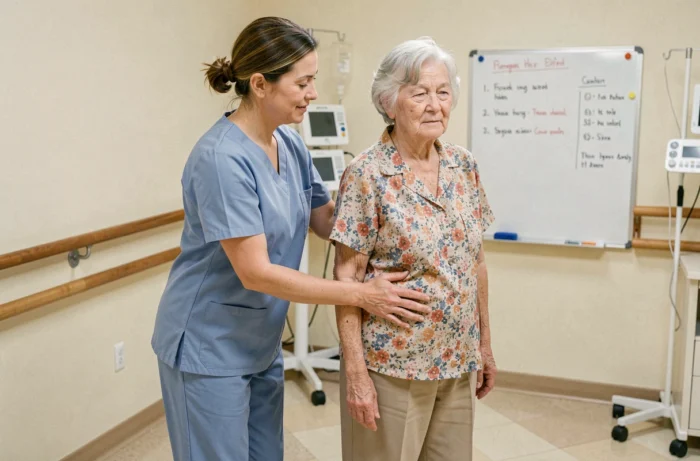
The Tinetti test remains the reference tool for assessing static and dynamic balance in geriatrics. However, its scoring varies from one version to another, which poses a concrete problem of inter-rater reliability in nursing homes. Here, we detail the technical points to master in order to properly utilize a simplified PDF version and integrate it into a structured fall prevention approach.
Tinetti Scoring: Two Versions That Say Different Things
The most common confusion concerns the maximum score. The original Tinetti version known as POMA (Performance Oriented Mobility Assessment) distinguishes a balance score of 16 and a walking score of 12, for a total of 28. Other grids, particularly those disseminated on French-speaking geriatrics websites, offer a balance score of 26 and a walking score of 9, for a total of 35.
This is not a detail. In the version with a total of 28, a score below 19 indicates a high risk of falling. In the version with a total of 35, the logic is reversed: the higher the score, the greater the risk. Using a decision threshold derived from the wrong version skews clinical interpretation and can lead to underestimating or overestimating the risk for a resident.
We recommend systematically checking, on the PDF used internally, the number of items per section, the maximum score, and the scoring direction (0 = normal or 0 = abnormal). A document that has been circulating for several years in a department may be a hybrid version, copied from heterogeneous sources. Using the simplified Tinetti test in PDF helps eliminate this ambiguity by providing a harmonized grid that is directly usable by care teams.

Tinetti Ceiling Effect: Why a Normal Score Is Not Enough
A resident who achieves the maximum score on the Tinetti is not necessarily safe from falling. This is known as the ceiling effect: the grid no longer discriminates profiles once the functional level is moderately preserved. Recently admitted residents or those with mild cognitive decline without significant motor impairment quickly saturate the scale.
Recent clinical recommendations emphasize combining the Tinetti with other complementary tests to compensate for this limitation. Three tests consistently stand out:
- The Timed Up and Go (TUG), which measures the time needed to stand up, walk three meters, turn around, and sit back down. It captures the speed component and postural transitions that the Tinetti scores in a binary manner.
- The single-leg stance test, which assesses static balance under reduced base of support conditions. It detects instabilities that the Tinetti’s bipedal stance does not reveal.
- The Short Physical Performance Battery (SPPB), a composite battery that includes walking speed, repeated chair stands, and tandem balance. Its sensitivity to change is greater than that of the Tinetti for tracking functional evolution over time.
Combining the Tinetti with at least one of these tests reduces the risk of false negatives and provides a more comprehensive functional profile during medical handovers.
Tinetti and Multifactorial Fall Assessment in Nursing Homes
The Tinetti only covers two dimensions of fall risk: balance and walking. International guidelines published in recent years clearly reposition this tool within a broader multifactorial framework. An isolated Tinetti score does not capture the pharmacological, psychological, and environmental dimensions of risk.
In practice, a structured fall risk assessment in nursing homes should articulate the Tinetti with:
- A review of medication treatments, focusing on psychotropics, antihypertensives, and polypharmacy with more than four therapeutic classes.
- Screening for fear of falling, often underestimated, which leads to activity restriction that accelerates deconditioning.
- An environmental audit of the living space (lighting, flooring, furniture, footwear), which is more related to occupational therapy but directly affects the relevance of motor scores.
- A minimal cognitive assessment, as attentional disorders modify the reliability of the assessment itself.
This approach meets the requirements of the HAS regarding patient safety and the prevention of serious adverse events in institutions.

Administration Conditions and Inter-Rater Reliability
The simplification of the PDF does not exempt the need to standardize administration conditions. The Tinetti is performed without orthopedic shoes unless regularly worn, on a flat surface, in a corridor of at least six meters. The chair used for the balance section must be rigid, without armrests. These parameters, often overlooked, directly influence the reproducibility of the score.
Inter-rater variability is the main weakness of the Tinetti in the nursing home context. A trained nursing assistant and a private physiotherapist will not score the item “stability in standing with feet together” or “symmetry of steps” in the same way. We observe that establishments that achieve the best concordance between evaluators are those that organize at least one annual calibration session, where several professionals simultaneously score the same resident and then compare their results.
Frequency of Reevaluation
A Tinetti performed only once at admission loses its predictive value within a few months. Quarterly reevaluation, or after any intercurrent event (fall, hospitalization, change in treatment), allows for tracking functional trajectory and adjusting the care plan. The simplified PDF facilitates this regularity by reducing the time for administration and transcription.
The challenge for teams in nursing homes is not so much to choose between the Tinetti and another test but to use it correctly, within a protocolized framework, with stable administration conditions and an interpretation that goes beyond the raw score. A good tool used poorly leads to bad clinical decisions, and the simplification of the support never replaces the rigor of the method.